Friday, September 16, 2011

Lifesaving Gray Water

It happens every time we have water rationing: Homeowners appear on the local news, bewailing the fact that their shrubs are dying in the drought. Every time that happens, I can't help shaking my head. Because in most cases, that didn't have to happen.

We've developed into a use-it-and-throw-it-away society. And that goes for the water that comes out of our taps. Right now, for those in the Southern Plains who are locked into exceptional drought conditions, letting precious water simply pour down the drain is a luxury that can be ill afforded.

                                      National Oceanic & Atmospheric Administration/
                                                               Department of Commerce

Each day, we let enough tap water slip through our hands (often literally) to keep at least some of our landscape plants alive during dry spells. Shrubs and new transplants—both trees and shrubs—in particular can subsist on regular doses of gray water alone.

Two years ago, I tested that. In one calendar year, I placed a bucket in the kitchen sink to collect water. (If you use "green" dish soap, you can use rinse water and dip water from the wash sink.) I also dipped water from baths and showers. From a two-person household that is notoriously stingy with natural resources anyway, I was able to contribute more than 4,000 gallons of water to my landscape plants.

But during serious dry spells, you need a strategy to get the most out of this "extra" water resource.

• Concentrate on watering shrubs and new transplants. (Mature trees and large hedges require far more water than you can provide with buckets of gray water.)

• Pour each bucketful of water in one place, rather than splashing it around. (You want the water to soak into the soil as deeply as possible to reach feeder roots.) Then pour the next bucketful next to that until you've worked all the way around the plant.

• Concentrate on soaking the ground out to the drip line beneath each plant, beginning a foot from the trunk.

• Water all the way around each plant before moving on to the next. (Obviously, you'll need to prioritize, watering the most valuable and the neediest plants first.)

One caveat: If you're thinking of hooking up your washing machine so it can water your trees, be aware that this isn't allowed in most municipalities. Check with your community's code-enforcement office. If you are permitted to pipe gray water directly, be sure not to empty hot water into the landscape; use only "green" detergents; and preferably empty laundry water into a vat or barrel where it can be diluted with clean water before final release into the landscape. And...and...monitor moisture levels closely, being careful not to drown plants.

For more on life-saving gray water, check out: http://greywateraction.org/greywater-recycling

Wednesday, September 14, 2011

To Feed, Or Not To Feed, That Is The Question

Your tree has stood in flood waters for weeks, or suffered through a long, brutal drought. Or major limbs were lost in a storm. Or maybe the poor thing was partially tipped over by high winds, and you've had to straighten it up and brace it. Whatever the insult, the tree now looks some the worse for wear, and you're anxious to make it healthy again.

So out comes the bag of fertilizer and...

DON'T! Just don't.

If there is one thing you should not do "for" a damaged tree, it's fertilize it. (The exception: if your soil is deficient in nutrients—and that has been confirmed by a soil test. Even then, only the deficient nutrients should be applied.)

I inadvertently broke that rule several years ago, after our beautiful pin oak was severely damaged by an ice storm. Come spring, I spread organic fertilizer on the grass, remembering too late that I needed to keep it well away from the tree's expansive root system. Sure enough, the injured tree put on a spectacular spurt of growth that year—which was not good.

When a tree is damaged—especially when it suffers root loss—it needs to pour everything it has into healing wounds and regenerating feeder and anchor roots. It cannot do that when its energy is being diverted into growing lush new leaves and branches.

Initially, fertilizer might give you what you want: a landscape specimen with a lush, green crown. From all appearances, your tree will have made a miraculous recovery.

But if the flush of new growth pushes the tree past its capacity to sustain, and the healing process stalls, your prized specimen could become even more susceptible to attack by diseases or pests. This year's miracle recovery can turn into next year's sudden decline.

In the case of our pin oak, we were lucky. The tree managed to heal its many wounds over the next few years despite the dose of fertilizer. But that healing would undoubtedly have progressed much faster if the oak hadn't been forced to support an unnecessarily luxuriant crown.

So what can you do for a damaged tree once any needed pruning repairs have been made? Of course, the tree will need a steady supply of soil moisture, especially inside its drip line. And if the specimen is particularly valuable to your landscape, you might consult a certified arborist as to whether it would be advisable to have it treated with growth retardant. (See Surviving Dead Roots, posted on 9/9/11.) This will keep crown growth minimal during the healing period, while enhancing root growth.

Other than that, one of the best things you can give your recuperating tree is time...time to catch its breath and heal.

Monday, September 12, 2011

Lessons From New Orleans

In 2005, the world watched in horror as flood waters inundated much of New Orleans, Louisiana. Earlier this year, a massive tornado swept away a large part of Joplin, Missouri. This month, wildfires of epic proportions have charred large swaths of Texas. The costs in precious lives and property from these and other recent natural disasters have been devastating.

But for most people, disasters are usually "over there," soon to be forgotten as the next big event hits the news. It is the individual loss that kicks you in the gut and breaks your heart.

I learned this several years ago when I experienced my first real disaster, in the form a catastrophic and deadly storm that left several states locked in a sheet of ice. The sheer tonnage of frozen stuff killed or damaged tens of thousands of trees and shrubs in my community alone, destroying 20 percent of the urban canopy. Trees fell through roofs, uprooted buried utilities, and blocked entire streets. Some parts of town were without power for weeks in bitterly cold temperatures.

But it was huge limbs that crashed down on my roof hour after hour—snapping tree trunks that boomed like cannon shots in my front yard—and power that no longer drove my furnace, that made me truly grasp the deep emotional toll that a disaster can exact. Even after all the debris had been cleared away and the damage repaired, I was left with a case of Post Traumatic Stress Disorder.

As New Orleans and Joplin and Texas know, there are wounds to the soul that cannot be healed with bricks and mortar. Certainly, we can never replace lost lives. And though we often can replace lost or damaged homes and businesses,  man-made structures cannot restore that vital element that we so often take for granted until it's gone: the visual tapestry and environmental anchor of our community's urban forest.

Aware of the importance of trees to both the environment of the city and the psyche of its population, New Orleans—still on its knees after the flooding from Hurricane Katrina—set out to test the restorative powers of re-greening.

With 75 percent of the city's famous trees drowned, Parkway Partners' executive director, Jean Fahr, began recruiting local citizens to supplement municipal crews in an ambitious replanting campaign. Once tree-lined Elysian Fields Avenue alone received more than 200 magnolias and oaks. Six thousand more trees soon went into surrounding neighborhoods, and the long-term planting program continues.

The response to this re-greening effort was amazing among citizens still grieving the loss of lives, property, and seemingly a way of life. The planting of new trees was akin to raising a flag on a ravaged battlefield. Passing drivers honked as workers dropped root balls into holes along Elysian Fields Avenue. One morning, a businessman in office attire on his way to work (see white shirt below) stopped to lend a hand. The spirit and pride of the city was returning one green tree at a time.

                                                                          Parkway Partners

Trees—green, living trees that cast shade and fill the air with birdsong—help us to reroot our own lives. And as they grow and prosper and once again fill out the scenery of our lives, we too heal.

New Orleans learned that. So can we all.

Friday, September 9, 2011

Surviving Dead Roots

When we moved to our new location last spring, I noticed a large post oak had suffered massive root loss from a recent construction project nearby. This caused me considerable angst. The tree is an important element of our backyard landscape, providing much-needed shade during our blistering hot summers while softening the appearance of the sizable structure that had been plunked down in its root zone.

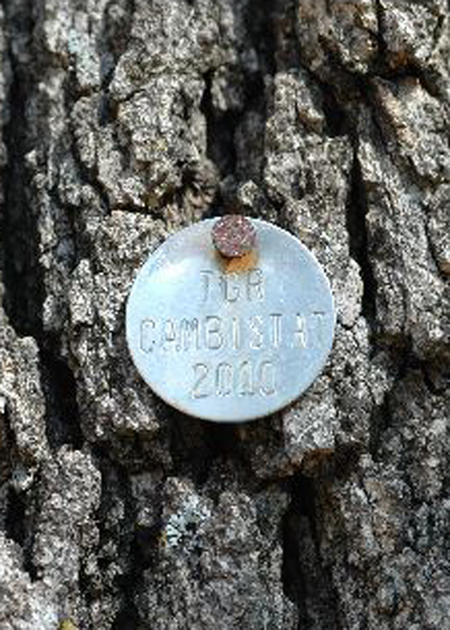
After several weeks, I noticed a small metal tag tacked to the tree's trunk. On closer inspection, the tag read: TGR CAMBISTAT 2010. The "2010" presumably indicated the year the tag had been attached to the tree.


The Internet is a wonderful thing. Five minutes later, I learned that Cambistat is a growth regulator applied to the soil, often to reduce tree growth beneath power lines. But in the case of my root-damaged oak, it was used to retard the top growth so more energy could be channeled toward growing denser roots that, in turn, could store more energy. Cambistat also increases chlorophyll production, so the leaves, though smaller, are darker green, which enhances photosynthesis.

This is an excellent way to help save storm-ravaged trees that have root damage caused by flooding, drought, or partial uprooting. As advertised, Cambistat also increases a tree's insect and disease tolerance (often a major problem for stressed specimens), and improves its heat and drought resistance.

And the old oak needs all of that.

As if the root damage weren't bad enough, the tree was badly defoliated by a catastrophic hailstorm last spring. In addition, it is still suffering through the hottest summer of its long life, including more than 60 days with temperatures at or above 100F...so far. And it is trying to endure a grinding drought that has killed many, many trees all over town.

Through all this, I've concentrated on regularly deep-soaking the soil at least out to the oak's drip line, so the remaining roots within this "critical root zone" won't dry out and die. Then, when we do have a rare half-inch of rain, it can do some good.

Still, as the unremitting severity of this summer wore on, I became more and more discouraged as to the big tree's prospects. But yesterday, I happened to be inspecting the foliage and discovered fresh new leaves sprouting from the tip of a branch.

So now I have renewed hope. Time will tell whether this wonderful tree will ultimately survive...and time can move very slowly. But a tree wants to live if it can. And maybe with the help of Cambistat, this one can.

Wednesday, September 7, 2011

One Tree At A Time

I love planting trees in my yard. Over the years, Robert and I have planted oaks and redbuds and maples and pecans, to name but a few. As we lower the rootball into its new home, it's always been easy to think that we're fulfilling our total obligation to maintaining and improving the urban forest.

And then I met Linda Goeringer.


When Linda noticed that the aging trees in her inner-city neighborhood were dying out, she took it upon herself to help remedy the situation.

Following a catastrophic ice storm that killed or damaged thousands of local trees, her city began giving away young trees to help restore the urban canopy. Linda got an idea. She stood in line at the tree giveaways, and planted her acquisitions along streetsides in her neighborhood.

But did she rest on her laurels after that? Absolutely not!

Linda can be seen regularly pulling a wagon of water down the street, heading off to tend to her young transplants. Three years have passed since her first tree went into the ground, and she's still providing them with TLC.

This past summer has been the most brutal in her state's history, resulting in the loss of one of her trees. But Linda remains undaunted. She plans to keep right on planting trees in her neighborhood.

Fifty years from now, I imagine people will walk and drive beneath the branches of Linda Goeringer's towering legacy...never wondering how the trees got there. Which makes me admire this big-hearted woman's commitment all the more.

And it makes me wonder just how much individual responsibility the rest of us feel we owe to the greater urban forests beyond our own yards.

Monday, September 5, 2011

Chainsaw Nightmares

Several years ago, I stepped outside to check on our arborist, Michael, who was cutting down a large, storm-shattered tree. Right away, I noticed a new tear in the knee of his jeans. He also had a slightly haunted look in his eyes.

As I approached, Michael spread the tear in his jeans and showed me a fresh Band-aid on his knee. He had just nipped it with the chainsaw. I shuddered. So did he, probably not for the first time. He had come this >-< close to sawing his kneecap in half.

This was a chainsaw expert who had been in the business of trimming trees for two decades. Michael was careful. Many times, I had seen him make a cut in a fallen limb, then glance up into the tree crown to make sure nothing else was about to fall. He could handle a chainsaw as deftly as a butter knife.

And yet, he had just come within a hair of doing severe damage to himself with one of the tools of his trade.


Above, you are looking at disaster with an easy-grip handle...if you don't carry precaution to the level of religion. In the wake of a natural disaster, homeowners aiming to save a buck turn up in hardware stores in droves, snapping up chainsaws. Many have never used one in their lives. But as hospital emergency room personnel can attest, many chainsaw wielders never imagine how much damage the tool can do—and how fast it can happen—until it's too late.

Chainsaws are designed to cut through hardwood. Think about that. A sharp chainsaw blade can slice through a tree limb as big around as you thigh within seconds. Need I say more?

So just a few tips to help save you a trip to the hospital:

—If you have never used a chainsaw, read the instructions carefully...twice. Better yet, apprentice with someone who is experienced.

—Don't use a chainsaw over your head.

—Do use hearing and eye protection.

—For major jobs such as felling a large tree, call an arborist. Sometimes trying to save a buck can result in a substantial medical bill.

(Weatherproofing Your Landscape—the book—contains further chainsaw pointers, as well as pruning tips.)

I'm sure Michael had flashbacks on that too-close-for-comfort chainsaw moment, possibly in his sleep. I certainly did. But I also realized that, in the hands of a less experienced and wary operator, the chainsaw probably would have done much more damage.

So be careful out there! I'd love to hear about your experiences with chainsaws.

Friday, September 2, 2011

Tree of Infamy

As if I needed a reminder of how bad the Eastern red cedar invasion has become in the Southwest, this week brought that problem front and center. The prolific tree is taking over millions of acres, crowding out native oaks and just about every other species as they spread. And that isn't all.


When wildfires occur, volatile Eastern red cedars ignite like torches, creating raging infernos. A case in point: in Oklahoma City, the invaders fueled wildfires covering 18 square miles last week, burning dozens of  houses and scores of vehicles...and the fire danger continues. Just yesterday, a wildfire came disturbingly close to us (see yesterday's post).

Ironically, fire once controlled the pest, as ranchers (and before them, Native Americans) periodically burned off vast expanses of grasslands in an annual rite of renewal. In these conflagrations, cedar seedlings didn't have a chance. But as small farms and ranches have gone by the wayside, seedlings have been spared...by the millions. After seven years or so,  young trees are mature enough to cast their own seeds to the wind, so the problem keeps growing exponentially.

It's hard to say how this invasive genie is ever going to get put back into the bottle. The numbers of Eastern red cedars have become so astronomical over the past several decades that the cost of irradicating them boggles the mind. Meanwhile, a growning number of cities are banning the buying, selling, transporting, and planting of the plant.

Recently, entire new industries have begun popping up, aiming to take advantage of what some see as a rich new source of raw materials. Eventually, Eastern red cedars could become an important energy source, turned into fuel for power plants. But Eastern red cedars are like used tires (which are already used as fuel), in that it will take a lot of power plants to use them up faster than they can reproduce.

For my part, all I can do is make sure the trees don't get a toe-hold on my property. And when it comes to store-bought mulch, I stick with cedar, doing my small part to help turn back the Great Eastern Red Cedar Invasion.